
Key takeaways
- Adult-focused, mixed-age, and family daypart models require different zoning, staffing, capacity, and product decisions.
- Select activities by repeatability and operating fit—not by how dramatic they look in a rendering.
- Separate standards and evidence by attraction category; one certificate cannot cover an entire mixed FEC by implication.
- Compare factory price, landed cost, installed cost, owner-side work, and opening budget as separate layers.
- Submit the venue, audience, operation, delivery, and approval assumptions before asking for a reliable proposal.
First decide what role adults play in the venue
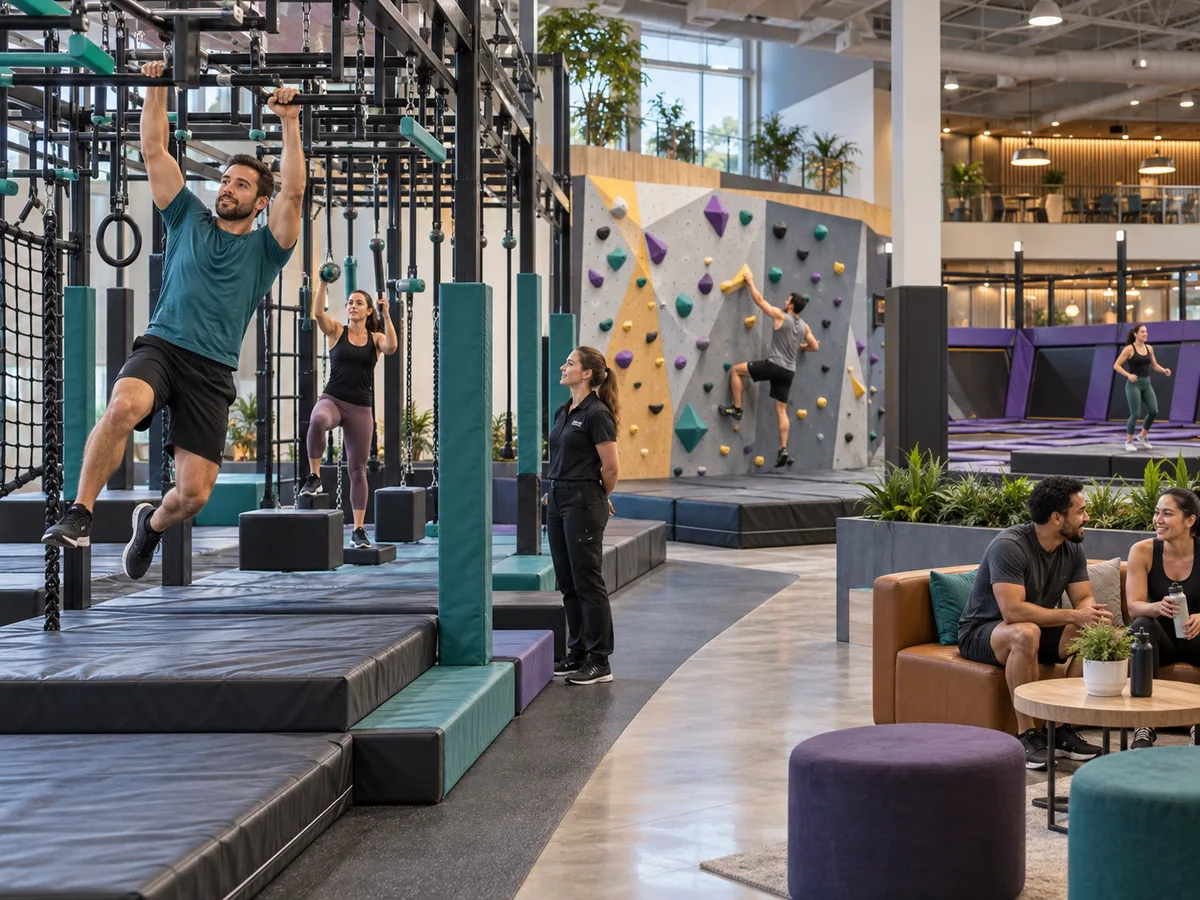
The phrase indoor playground for adults can describe several businesses: an adult-first obstacle or social-sports venue, a family entertainment center with adult-capable zones, an evening daypart inside a mixed venue, or a group-events product for corporate, party, league, and team-building visits. Each model changes the equipment mix, peak times, supervision, pricing, food and beverage relationship, and expected dwell time.
Write one primary visit occasion before designing. A venue built for repeat skill progression needs different activities from a one-time group event. A mall FEC balancing parents and children needs different circulation from an adult-only challenge hall. If the commercial model is unclear, suppliers will usually fill the plan with available products rather than solve the operator's real decision.
Buyer decision: define whether adults are the main customer, a compatible mixed-age customer, or a controlled session type before selecting attractions.
Compare activity formats by operating fit
A strong adult offer usually combines low-barrier participation with visible progression. The first activity should be understandable without expert skill, while deeper zones reward repeat visits, competition, or coached development. Social viewing, recovery, queueing, and photography moments also shape the experience even though they are not equipment line items.
Do not assume every high-energy product belongs in one contract or follows one approval path. Ask each supplier to identify the activity category, intended use, user conditions, governing documents, operating limitations, and responsible manufacturer for the exact proposed configuration.
| Activity direction | Best fit | Operating tradeoff | Evidence to request |
|---|---|---|---|
| Ninja and obstacle lanes | Timed challenges, leagues, social competition, repeat progression | Throughput, skill differences, falls, reset time, and staff visibility | Final obstacle schedule, user conditions, landing approach, inspection access, spare and replacement plan |
| Bouldering and climbing | Skill progression, coaching, longer dwell, club or membership programs | Route management, height and fall controls, staffing competence, rescue where applicable | System classification, wall and hold documents, structural interfaces, operating and inspection procedures |
| Trampoline activity zones | Open sessions, fitness, sport games, group events, mixed FECs | Size and skill separation, briefings, court supervision, landing and capacity control | Court classification, manufacturer instructions, information plates, inspection and maintenance scope |
| Interactive sport challenges | Short competitive rounds, spectators, corporate groups, replay value | Technology support, calibration, queues, software and replacement dependencies | Equipment specification, operating manual, electrical scope, service response, software and spare-parts terms |
| Soft challenge and entry activities | Warm-up, lower-barrier participation, mixed ability groups, transition zones | May improve inclusion but can be crowded if circulation and capacity are unclear | User group, material build-up, capacity basis, cleaning, inspection, and replacement details |
| Social and spectator zones | Food and beverage, parties, corporate events, recovery, group coordination | Uses floor area but supports dwell, spend, visibility, and non-participant comfort | Sightline plan, circulation, furniture and barrier scope, acoustics, cleaning and local fit-out responsibilities |
Separate adult capability from mixed-age compatibility
Equipment strong enough for adults is not automatically suitable for adults and smaller children to use together. Size, speed, reach, behavior, skill, landing, and route choice can create incompatibilities even when every participant meets a simple age or height rule. Review each activity and transition point, then define the zones or sessions that can be shared.
Use a participation matrix that records intended users, abilities, restrictions, accompaniment rules, briefing, capacity, staff position, emergency response, and the document supporting each decision. Link the same rule set to booking pages, front-desk checks, wristbands, signs, briefings, and attendant procedures so the operating team can apply it consistently.
- Beginner and higher-skill progression rather than one undifferentiated challenge floor
- Adult-only, family, junior, coached, league, party, or corporate sessions where needed
- Visible boundaries between active movement, queues, exits, spectators, café, and recovery areas
- Capacity and staffing by zone, not only one whole-venue occupancy number
- Access, inclusive participation, health questions, refusal, exception, and escalation procedures
Choose between a factory, specialist, and coordinated project supplier
A China indoor playground factory can be appropriate when the buyer has a controlled design, local professional team, import experience, installation capability, and a clear product category. A specialist supplier may be stronger for a trampoline court, climbing system, aerial course, interactive product, or another category with distinct engineering and operating needs. A coordinated project supplier can reduce interface work when the venue combines several categories, but must still disclose the responsible entity and evidence for each one.
Do not select the delivery model from the company label alone. Verify which legal entity signs the contract and receives payment; which team designs; which factory manufactures; which items are sourced; who prepares calculations and documents; who inspects; who exports; who installs or supervises; and who owns the after-sales response. Record these responsibilities against the final equipment schedule.
| Model | Can fit when | Buyer must already control | Priority verification |
|---|---|---|---|
| Direct factory | The equipment category and specification are stable and the buyer can coordinate the remaining project | Design criteria, local approval, interfaces, freight, installation, commissioning, and operation | Legal and production identity, order-specific documents, inspection, packing, spares, and exclusions |
| Category specialist | One attraction carries distinct technical, operational, or service requirements | Interfaces with the building and other suppliers | Comparable systems, engineering scope, installer competence, inspection route, training, and ongoing service |
| Project coordinator | The venue combines several product categories and the buyer wants one coordination path | Local authority, professional, construction, and operator decisions | Transparent subcontracting, evidence ownership, revision control, responsibility matrix, and single issue-management process |
Request evidence tied to the quoted adult activity mix
A factory tour, promotional project video, or folder of generic certificates can support early confidence but cannot prove the final adult FEC configuration. Request a project evidence register that connects every activity to the controlling drawing, specification, responsible company, applicable requirement, production check, installation record, operating document, and unresolved buyer-side approval.
ASTM Committee F24 publishes standards across design and manufacture, testing, operation, maintenance, inspection, quality assurance, and adventure attractions. Its public materials identify distinct practices for trampoline courts and aerial adventure courses. This reinforces a practical procurement point: a mixed venue needs category-specific review and cannot use one document as blanket proof for every attraction. The destination authority, insurer, inspector, and competent local advisers must confirm what applies.
- Legal contracting entity, payment recipient, factories, sourced categories, and accountable contacts
- Controlling layout, activity schedule, revision register, loads and building interfaces where applicable
- Component-level material schedule and product-specific report or certificate scope
- Manufacturing, trial-assembly, measurement, inspection, nonconformance closure, and packing records
- Installation, completion, commissioning, information plates, operating manuals, staff inputs, and checklists
- Maintenance access, replacement parts, wear items, warranty process, response time, and change control
Compare the total opening scope, not only factory price
Adult-oriented attractions can shift cost toward structure, height, landing systems, electronics, specialist installation, commissioning, training, inspection, rescue planning, and replacement parts. Separate the equipment price from packing and freight, import cost, local construction, installation, professional review, inspection, pre-opening preparation, operating equipment, contingency, and working capital.
Give every shortlisted supplier the same plan revision and ask it to mark each responsibility as included, excluded, optional, allowance, or buyer supplied. Then compare the first purchase price, landed cost, installed cost, opening budget, and likely lifecycle burden. A lower factory total can be the more expensive option when major interfaces and services remain unpriced.
| Cost layer | Typical items | Comparison question |
|---|---|---|
| Equipment package | Frames, obstacles, walls, courts, padding, electronics, graphics, spares | Is the same activity schedule, material build-up, capacity basis, and option set included? |
| Landed scope | Packing, inland transport, freight, insurance, duties, taxes, broker and destination charges | Who owns each risk and which trade, route, volume, and timing assumptions were used? |
| Installed attraction | Unloading, storage, labor, supervision, tools, access equipment, testing, inspection and commissioning | What must the site and local team provide before installers arrive? |
| Opening budget | Building works, approvals, training, uniforms, IT, café, marketing, pre-opening labor and contingency | Which costs sit outside the supplier contract but still control the opening date? |
| Lifecycle | Staffing, inspection, cleaning, wear parts, repairs, software, utilities and refresh | Can the operator maintain the experience and evidence after the launch? |
What to submit for a useful supplier proposal
Prepare one controlled brief with the destination, venue type, latest dimensioned floor plan, sections, clear-height and obstruction map, structural and service information, entrances and exits, site photos, adult and family audience assumptions, session model, target capacity, activity priorities, visual direction, social and food-and-beverage needs, staffing approach, budget range, delivery address, installation model, required documents, and opening target.
Ask Vabibo to return a marked zoning concept, activity schedule, option list, user and operating questions, evidence plan, responsibility matrix, commercial basis, and missing-information list against the same revision. This gives the buyer a defensible starting point for local professional review and a comparable quotation instead of a generic catalog proposal.
Next step: submit the floor plan and operating brief before asking for a final adult indoor playground layout or price.
Sources and related references
- ASTM International — Committee F24 Amusement Ride and Device Standards
- ASTM F2970-25 — Trampoline Courts
- ASTM F2959-26a — Aerial Adventure Courses
- IAAPA — Creating an Amusement Ride Standard Operating Procedures Manual
- Vabibo — Indoor Playground Supplier Audit Checklist
- Vabibo — Equipment Price vs Landed Installed Cost
This buyer guidance supports early planning. Final dimensions, standards, responsibilities, and approvals must be confirmed for the actual project and destination.